




By Ifunanya Ibeneme (Independent Journalist, Nigeria)
Goodluck left his aunt’s house years ago to fend for himself on Enugu’s streets. He is one of dozens of boys still sleeping rough across the city; within sight of free government schools they have never set foot in.
It was a hot, quiet Friday afternoon, a little past noon, when Goodluck and four younger boys sprawled across a wooden table and chairs chained to the roadside opposite Spar Mall in Enugu, waiting for the next passerby who might spare them money for food. When the rain came, they scattered for the cover of a nearby shawarma stand.
Goodluck, the oldest of the group, breathed heavily as he fought through an asthma attack. He was seven, in 2016, when his mother dying of cancer, sent him from their home in Ebonyi State to live with an aunt in Enugu. He says his cousins there mistreated him, and in 2018, after dropping out of school in Primary 6, he left for the street.
“I’m a man. I need to fend for myself. When I left my aunt’s house, I didn’t want to depend on my elder sister and her husband who are not financially stable, so I chose to live on the street,” Goodluck said.
He is 17 now. He has been on the street for seven years.
Goodluck is not alone. His companions; Chidera, Chinedu, Uche and Jude range from 13 to 16 years old. All dropped out between Primary 3 and Primary 6. All are from Southeast Nigerian states. All are living on the streets of Enugu.
They are part of a staggering national crisis. Nigeria’s Federal Ministry of Education has cited a working estimate of more than 14.8 million out-of-school children nationally, while UNICEF and UNESCO have long put the number at 18.3 million to 20 million meaning, by the higher estimate, roughly one in three Nigerian children is not in school, and Nigeria accounts for about one in every five of the world’s out-of-school children. In May 2026, Education Minister Tunji Alausa pushed back on those wider figures, telling Channels Television that an ongoing state-by-state mapping exercise suggests the real number may be below eight million though he acknowledged even that lower figure would remain unacceptably high.
UNICEF also estimates that more than eight million children in Nigeria are street-connected children who left home because of poverty, a parent’s death, or domestic neglect, and who are now vulnerable to exploitation, abuse, and social stigma.
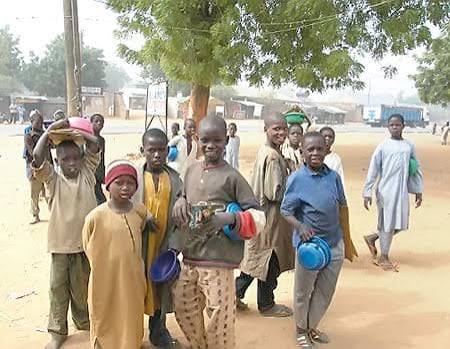
“Whenever people insult me, I remember my mother that I didn’t get to experience while growing up. It always makes me cry,” said Chidera, 14, who dropped out in Primary 4.
“My major pain right now is my health. It was after my mother’s death that my asthma was discovered, so I can’t do hard jobs like pushing a barrow. I only help people dispose of rubbish and pick metal and beverage scraps to sell,” Goodluck said.
The street opposite Spar Mall has become their world. They greet passers-by, run errands, and survive on whatever kindness the day brings.
What the neighbours see
Ibrahim, a POS business owner whose shop sits directly opposite where the boys gather, has been observing them.
“Anybody that comes to do a transaction, they will beg them. Some people give them ₦1,000, some ₦500, and they use it to sustain themselves. Usually they buy foodstuffs, or if someone gives them indomie noodles, they cook here by the roadside in the evening when we’re done with business,” he said. But not all the money goes to food. “One thing I have noticed is that they also use money to drink alcohol,” Ibrahim added.
It is a detail that sits uneasily alongside their ages, the youngest of them is 13.
A woman who has tried to help
Mrs. Judith, who runs the food stall where the boys regularly buy meals and has known them for years, offers a deeper picture. She has fed them, guided them, and quietly tried to change their trajectory.
“For over two or three years, I have been seeing these boys roaming around. A man once helped to enroll three of them to learn furniture making, and I promised to give them free food which I did for three months. One of them successfully left the street, but two did not complete the training and quit,” she said.
Mrs. Judith also helped connect Goodluck to a cleaning job at Spar Mall. He worked there for a year, then travelled to see relatives. When he returned to the street, the job was gone. She speaks of the boys with the particular knowledge of someone they trust. According to her, the boys smoke; even the younger ones, and even Goodluck, who lives with Asthma.
“Helping them to stop smoking is one of the first things that needs to happen,” Mrs. Judith said.
Nights on a green carpet
Nwanni, who owns the indomie stall that doubles as the boys’ shelter on cold nights, has seen a different kind of change in them over time.
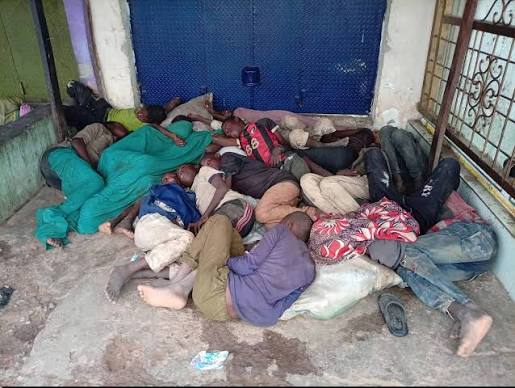
“Most of them have good character, while some have bad character. Sometimes when I come to my shop in the morning, I still find them sleeping here. Some of them do not have parents. A psychiatric hospital used to come by and pick up some of them because they usually looked dirty but they always found a way to escape and come back. Now, some of them take their bath and look neat,” Nwanni said.
It is a small dignity. But on the street, small dignities matter.
The boys revealed that some nights, up to 12 of them sleep on the green carpet by the entrance of a nearby lounge, or inside Nwanni’s dilapidated stall. In the morning, they disperse across the city: to Ogbete market, to Abakpa, pushing barrows, collecting scrap, disposing of rubbish, surviving.
They were supposed to be in secondary school.
Ibrahim puts the number even higher. “There are more than 20 boys who sleep here,” he said.
“Sometimes they go to other neighbourhoods, like WEAC and Agric Bank, to sleep.”
Promises within reach
According to the National Bureau of Statistics, Enugu ranks second highest in the Southeast for out-of-school children, with a rate of 7.5 percent. The Enugu State Government has responded with Governor Peter Mbah’s Smart Green Schools project, intended to put one free, fully resourced school in each of the state’s 260 wards, complete with free tuition, meals, uniforms and books. By April 2026, the government said it had earmarked ₦30 billion to feed roughly 260,000 pupils across the schools, though independent reporting that same season found the rollout uneven, with some of the older public schools the new system was meant to replace still standing in disrepair.
In an interview with TechCabal, Chinyere Onyeisi, the governor’s Special Adviser on Education Innovation, said the existence of the schools removes any excuse for a child to be out of class. “You see a child on the street, you can now ask: What are you doing here?” she said. “Because now you have smart schools, they are free, they provide food, uniforms, books; there’s no excuse not to be in school.”
But these boys are still on the street. Ibrahim does not mince his words about what he believes needs to happen.
“The government has to do something about these children. Government is supposed to make provisions to gather them, take care of them, and send them to school. There should be a particular place where these kinds of boys should be staying, to avoid reckless behaviour in the society. If care is not taken, such boys can become armed robbers,” he said.
It is a fear rooted in proximity, the daily reality of watching children grow up on the street with no intervention in sight.
Dreams the street hasn’t taken
Yet underneath the hardship, the boys carry dreams that the street has not yet extinguished.
Jude, who once told his father he wanted to be a doctor, said that dream has not left him.
Chukwuemeka, another boy who sleeps at the stall most nights whose father lost both legs and whose mother washes clothes to make ends meet wants to learn furniture making and return to school: the same trade that a stranger once tried to teach three of his companions, before two of them walked away.
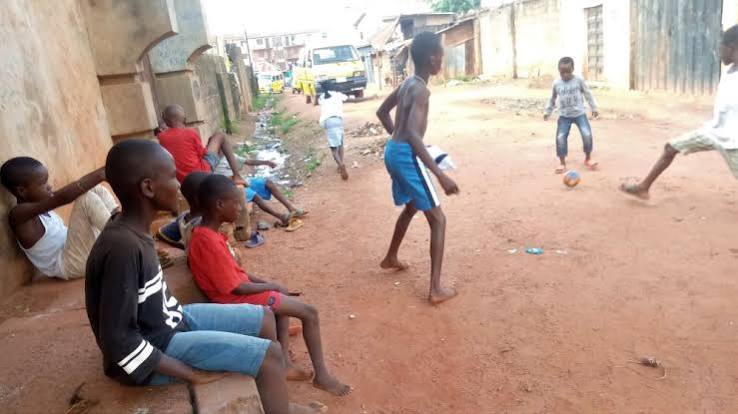
And Goodluck, asthmatic and street-hardened; still dreams of becoming a celebrity musician and a businessman, inspired by the Enugu-born rapper Jeriq the hustler.
“I know I am a talented artist, but because of resources, sometimes I feel like I am wasting my time,” Goodluck said. They are not wasting time. They are waiting for someone to come and take them off the street.
For a chance at the future they can still clearly see.
The Smart Green Schools, built with hostels and free meals, sit within reach of these boys yet no outreach mechanism exists to bring them through the gates. The solution is not new infrastructure. It is the will to use what already exists.
“Giving them small, small money is not the solution,” Mrs. Judith said quietly and firmly.
Ifunanya Ibeneme is an independent journalist based in Nigeria.

Sources & further reading
Onyeisi interview and Smart Green Schools rollout — TechCabal, April 17, 2026: techcabal.com/2026/04/17/enugu-smart-schools
Investigation into Enugu’s older public schools left in disrepair — The Cable, May 16, 2026: thecable.ng/investigation-enugu-smart-schools
Education Minister Tunji Alausa disputes UNICEF/UNESCO figures — Channels Television, May 12,