





U.S. President Donald Trump has signed an executive order replacing the terms “Artificial Intelligence” and “AI” with “Super Intelligence” and “SI” across the entire executive branch.
The administration stated that “artificial” makes the technology sound fake, and that “Super Intelligence” better represents its power and potential.
U.S. government agencies, official correspondence, public communications, and policy documents have been instructed to use “SI” and stop acknowledging the term “AI”
Tech companies and researchers are however continuing to use “Artificial Intelligence” (AI)
Donald Trump posited that the name artificial intelligence sounds “fake” and has ordered US agencies to use “Super Intelligence” instead. Yet, tech firms and researchers have little reason to play along.
Earlier this month, the US president claimed on his Truth Social platform that the term artificial intelligence is “inaccurate” and “ineloquent.” He said “superior,” “extreme,” or “supreme” intelligence were better alternatives.
In a three-day social media poll, Trump fans chose “Super Intelligence” (SI) by about 65% to 35% (for Superior Intelligence), allowing him to announce at the United Nations General Assembly last week that US federal documents would use his new term going forward.
‘AI is not Super Intelligence’
The tech industry has yet to adopt the phrase, however, while academics warn that superintelligence is a future term for when technology can beat humans across the board. They say the current AI models are years away from that milestone.
“Most AI is not superintelligence — it’s just different intelligence,” Pedro Domingos, a computer science professor from the University of Washington, told DW. “AI is doing different things from what humans do, so calling it superintelligence is misleading.”
The History of Artificial Intelligence (AI)
Computer scientists and mathematicians coined the name “artificial intelligence” in 1956 at a summer workshop at Dartmouth College in New Hampshire. “Artificial” simply meant made by humans, as opposed to natural human intelligence.

Not all experts agreed with the name. In the book “Machines Who Think,” historian Pamela McCorduck cited AI pioneer Arthur Samuel, who said the term “makes you think there’s something kind of phony about this.” Despite this, the name artificial intelligence has stuck for 70 years. Critics say changing it now will not quieten the many fears around AI, including job losses, human obsolescence or machines slipping out of our control.
Tech experts have indicated that the “rebrand” won’t quell AI fears.
“The name change is fostering these kinds of fears: ‘Oh, this is superintelligence and it’s going to make humans obsolete, turn on us and take our jobs’,” warned Domingos. “If you want to maximize the backlash against AI, rename it Superior Intelligence.”
Those public fears are growing fast. In a Public First poll for Politico earlier this month, about half of respondents in six countries — the United States, Canada, France, Spain, Germany and the United Kingdom — backed a pause in further AI development to reduce the risk that the new tech could destroy humanity.
A separate CNN/SSRS poll found nearly nine in 10 Americans are more concerned than excited about AI surpassing human intelligence.
Those concerns have already reached the US Congress. Last week, Vermont’s independent Senator Bernie Sanders co-introduced a bill to “permanently ban the development of artificial superintelligence” that humans cannot control. The legislation also calls for a pause on advanced AI development until federal testing and oversight are in place.
Is this a branding gift to aid the current boom of AI?
Trump’s new term could, however, suit the major US AI players, who are keen to play up their advanced models. Those systems already outperform humans on many specialized tasks and until recently were far ahead of China.
Yet both Anthropic, the firm behind the Claude model, and OpenAI, which created ChatGPT, have pushed back plans to go public. Some market watchers blamed the delays on recent scares where AI models hacked into computer systems or ran tasks they were not meant to.
With Chinese models closing much of the quality gap with much less computing power, US labs may still appreciate the branding that helps confirm they are still leading the AI race. Global spending on AI is expected to surpass $1 trillion (€880 billion), according to Goldman Sachs research.
Superintelligence still remains a moving target
While the current AI models keep improving and can already run many tasks on their own, the next step that many labs discuss is AI systems that improve themselves. That’s called recursive self-improvement or RSI.
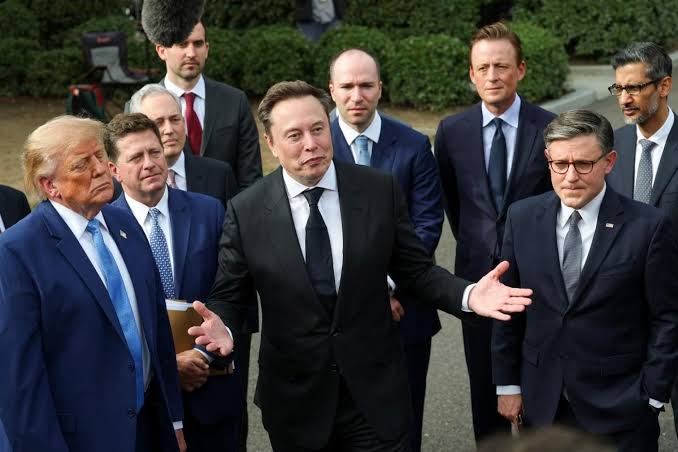
On that journey, Elon Musk has predicted that AI learning could be automated, with limited human input, by the end of this year or 2027. OpenAI thinks it could take a year longer. But even then, AI systems won’t be fully recursive.
Jürgen Schmidhuber, a German computer scientist based in Switzerland, argued in a blog post earlier this month that “full RSI, however, will require not just self-improving [AI] software but self-improving hardware in the physical world.”
In other words, to reach superintelligence or RSI, tech companies would have to produce chips, humanoid robots and even replace entire factories without human input.
While AI is already speeding up chip design, it cannot yet run the foundry alone. Self-improving machines, with no human input, are likely still decades away.
Beyond the science of machine learning, politics will likely play a bigger role in whether Super Intelligence sticks. While Trump claimed Chinese President Xi Jinping liked the name, China has yet to show any signs of changing from AI.
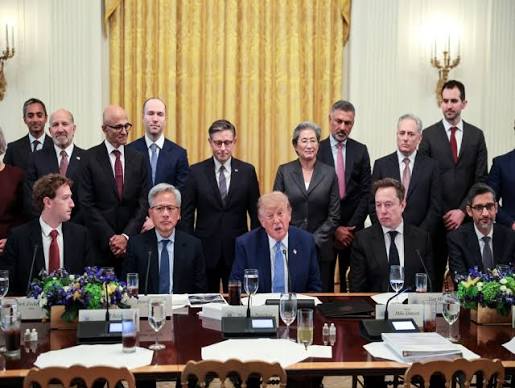
At the Tech Summit on Tuesday with key industry leaders, Trump signed an executive order instructing US government bodies and agencies to start using the term SI. While some Big Tech leaders have adopted it, experts say the new term is unlikely to catch on.
“Knowing the political orientation of most people in the [AI] field, they’re more likely to have the opposite reaction, which is: ‘To hell with you. We’re going to call it artificial intelligence even more than before’,” Domingos said.
Scientists note that “superintelligence” traditionally refers to a hypothetical future machine that surpasses all human intelligence, meaning the new label exaggerates what current AI can actually do.
Additional Sources: DW, BBC