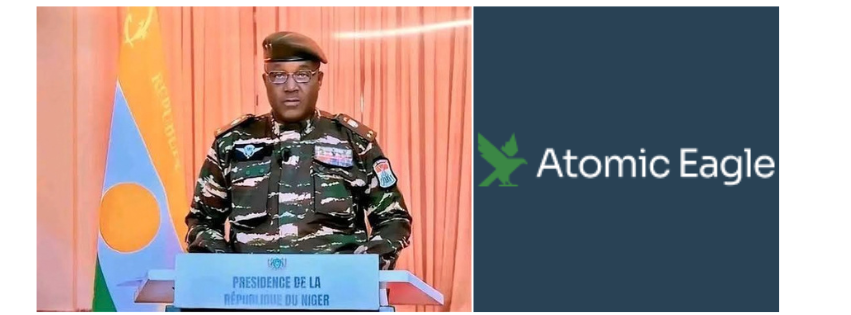
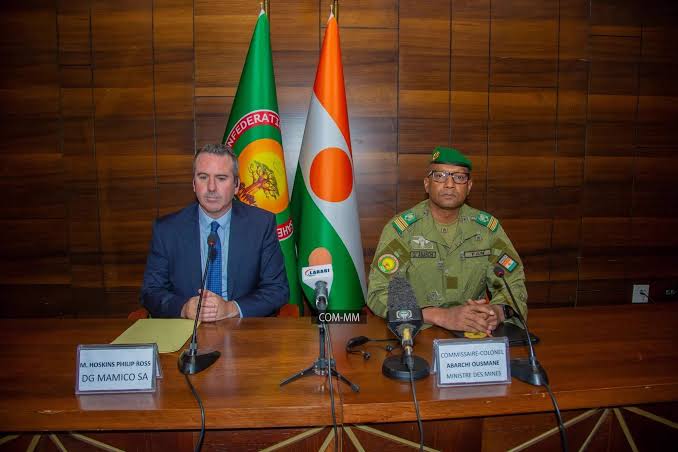
Niger Republic’s government has recently signed a new agreement with the Madaouela Mining Company (MAMICO) to relaunch a uranium mining project in the north of the country.
The junta that has ruled the West African country since a military coup in 2023 advocates sovereignty over the country’s mineral resources, including uranium.
MAMICO is 60% owned by the Australian Atomic Eagle group and 40% by the Niger government.
“The agreement provides, among other things, for the payment of an initial fee of $10 million, capacity-building for the mining administration, local development and the creation of around 1,000 jobs for young Nigeriens”, the mining ministry said in a statement on Facebook.
Uranium mining in Niger is also at the heart of a standoff between the country’s leaders and former colonial power France, which holds 90% of the capital of the Orano mining company.
Niger’s military authorities nationalized the local subsidiary of Orano as part of a wider pivot away from Paris and towards alternative allies such as Russia.
Orano has launched several legal proceedings of its own against Niger, accusing the junta of confiscating its assets in the unrest-hit country.
Niger’s Government and the French Orano story
The history behind Niger’s government and the French nuclear company Orano (formerly Areva) is defined by decades of unbalanced economic ties rooted in the colonial era, repeated pushback by Niamey for mineral sovereignty, and a dramatic final split following the 2023 military coup.
Niger gained independence from France in 1960, but 1960s uranium agreements granted French state entities a de facto monopoly over the resource.
The Société des Mines de l’Aïr (Somaïr) was created in 1967 to mine the Arlit deposit. While Niger supplied a massive share of French and European nuclear fuel consumption, the local government historically received only a tiny fraction of the revenues.
Former President Mamadou Tandja demanded fairer pricing and higher state royalties in the mid-2000s as global uranium demand surged. He brought in competition from the China Nuclear International Uranium Corporation (CNEC) to break the French monopoly, raising uranium prices via new agreements. Tandja was subsequently ousted in a 2010 military coup. It is alleged and speculated that the French government was silently behind this coup.
Following the July 2023 coup led by General Abdourahamane Tchiani, the new military government severed military and economic cooperation with France.
The government accused Orano of extracting an unfair share of historical production (claiming Orano took 86.3% of output since 1971 despite a 63% ownership stake).
Niger revoked Orano’s major mining permit at Imouraren in 2024 and moved to nationalize the Somaïr operation in 2025, driving the local subsidiary into a financial crisis and triggering international arbitration at the ICSID.
Additional Sources: The Africa Report , Africa News