





“THE ILLIQUIDITY TRAP IN THE REAL ESTATE MARKET: WHY PROPERTY-HEAVY PORTFOLIOS ACROSS AFRICA REQUIRES A RETHINK”
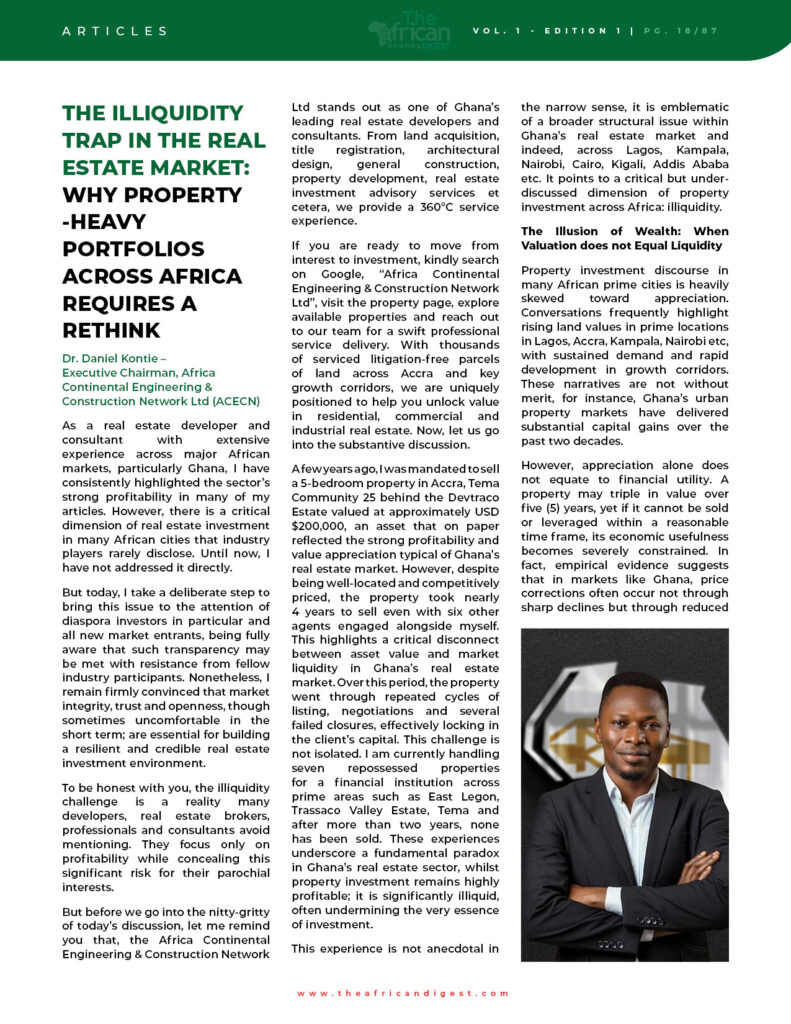
By Dr. Daniel Kontie – Executive Chairman, Africa Continental Engineering & Construction Network Ltd (ACECN)
Here are some of the excerpts
As a real estate developer and consultant with extensive experience across major African markets, particularly Ghana, I have consistently highlighted the sector’s strong profitability in many of my articles. However, there is a critical dimension of real estate investment in many African cities that industry players rarely disclose. Until now, I have not addressed it directly.
But today, I take a deliberate step to bring this issue to the attention of diaspora investors in particular and all new market entrants, being fully aware that such transparency may be met with resistance from fellow industry participants. Nonetheless, I remain firmly convinced that market integrity, trust and openness, though sometimes uncomfortable in the short term; are essential for building a resilient and credible real estate investment environment.

To be honest with you, the illiquidity challenge is a reality many developers, real estate brokers, professionals and consultants avoid mentioning. They focus only on profitability while concealing this significant risk for their parochial interests.
But before we go into the nitty-gritty of today’s discussion, let me remind you that, the Africa Continental Engineering & Construction Network Ltd stands out as one of Ghana’s leading real estate developers and consultants. From land acquisition, title registration, architectural design, general construction, property development, real estate investment advisory services et cetera, we provide a 360ºC service experience.
If you are ready to move from interest to investment, kindly search on Google, “Africa Continental Engineering & Construction Network Ltd”, visit the property page, explore available properties and reach out to our team for a swift professional service delivery. With thousands of serviced litigation-free parcels of land across Accra and key growth corridors, we are uniquely positioned to help you unlock value in residential, commercial and industrial real estate. Now, let us go into the substantive discussion.
A few years ago, I was mandated to sell a 5-bedroom property in Accra, Tema Community 25 behind the Devtraco Estate valued at approximately USD $200,000, an asset that on paper reflected the strong profitability and value appreciation typical of Ghana’s real estate market. However, despite being well-located and competitively priced, the property took nearly 4 years to sell even with six other agents engaged alongside myself. This highlights a critical disconnect between asset value and market liquidity in Ghana’s real estate market. Over this period, the property went through repeated cycles of listing, negotiations and several failed closures, effectively locking in the client’s capital. This challenge is not isolated. I am currently handling seven repossessed properties for a financial institution across prime areas such as East Legon, Trassaco Valley Estate, Tema and after more than two years, none has been sold. These experiences underscore a fundamental paradox in Ghana’s real estate sector, whilst property investment remains highly profitable; it is significantly illiquid, often undermining the very essence of investment.
This experience is not anecdotal in the narrow sense, it is emblematic of a broader structural issue within Ghana’s real estate market and indeed, across Lagos, Kampala, Nairobi, Cairo, Kigali, Addis Ababa etc. It points to a critical but under-discussed dimension of property investment across Africa: illiquidity.
The Illusion of Wealth: When Valuation does not Equal Liquidity
Property investment discourse in many African prime cities is heavily skewed toward appreciation. Conversations frequently highlight rising land values in prime locations in Lagos, Accra, Kampala, Nairobi etc, with sustained demand and rapid development in growth corridors. These narratives are not without merit, for instance, Ghana’s urban property markets have delivered substantial capital gains over the past two decades.
However, appreciation alone does not equate to financial utility. A property may triple in value over five (5) years, yet if it cannot be sold or leveraged within a reasonable time frame, its economic usefulness becomes severely constrained. In fact, empirical evidence suggests that in markets like Ghana, price corrections often occur not through sharp declines but through reduced transaction volumes and extended selling periods (Africanvestor, 2026). In effect, liquidity not price, absorbs market shocks.
This creates a persistent illusion of wealth. Investors appear financially robust based on asset valuations, yet their ability to deploy that wealth in response to real-world needs remains limited.
The Human Cost of Illiquidity
The implications of illiquidity extend beyond abstract financial theory into the lived realities of investors. During the 4year period it took me to sell the property in question, any urgent need for capital, whether for healthcare, education or business investment would have exposed a fundamental vulnerability.
In such scenarios, the asset’s nominal value becomes irrelevant. What matters is access. Without the ability to convert property into cash quickly or to borrow against it efficiently, the investor is left in a paradoxical position; asset-rich but cash-strapped. This phenomenon is increasingly recognized across African markets, where property ownership is often seen as a primary store of wealth but not necessarily a flexible financial instrument.
For the completion of this article, Download your Complimentary Copy of The Magazine by clicking the button below.