

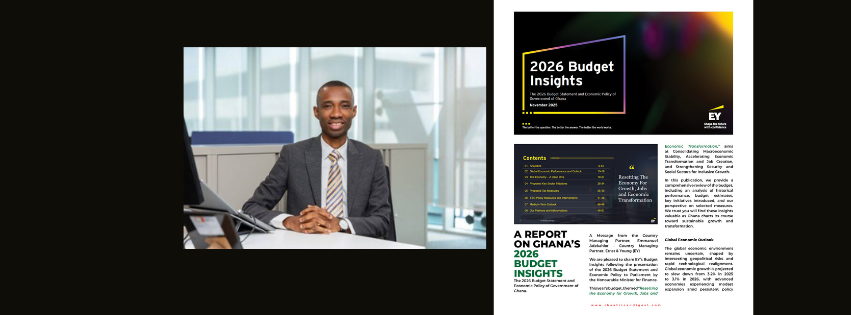
A Message from the Country Managing Partner; Emmanuel Adekahlor – Country Managing Partner, Ernst & Young (EY) Ghana
The 2026 Budget Statement and Economic Policy of Government of Ghana:
We are pleased to share EY’s Budget Insights following the presentation of the 2026 Budget Statement and Economic Policy to Parliament by the Honourable Minister for Finance.
This year’s budget, themed “Resetting the Economy for Growth, Jobs and Economic Transformation,” aims at Consolidating Macroeconomic Stability, Accelerating Economic Transformation and Job Creation, and Strengthening Security and Social Sectors for Inclusive Growth.
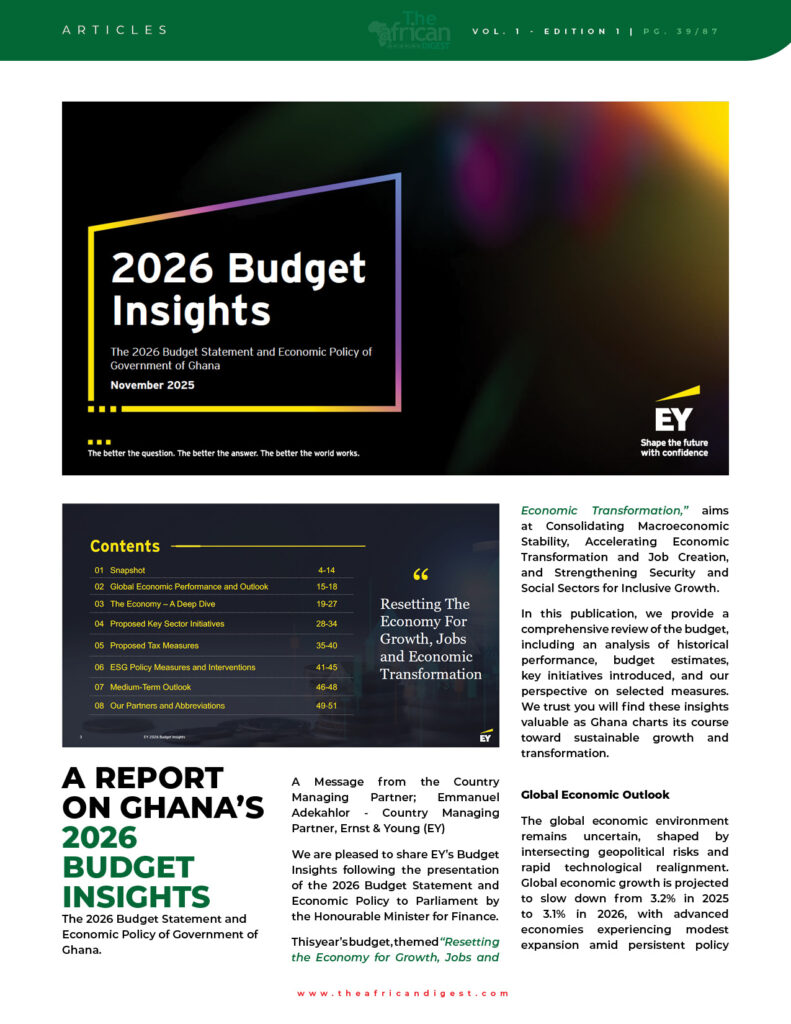
In this publication, we provide a comprehensive review of the budget, including an analysis of historical performance, budget estimates, key initiatives introduced, and our perspective on selected measures. We trust you will find these insights valuable as Ghana charts its course toward sustainable growth and transformation.
Global Economic Outlook
The global economic environment remains uncertain, shaped by intersecting geopolitical risks and rapid technological realignment. Global economic growth is projected to slow down from 3.2% in 2025 to 3.1% in 2026, with advanced economies experiencing modest expansion amid persistent policy uncertainty.
The United States is expected to grow by 2.1% in 2026, supported by a resilient labour market, while Europe faces slower recovery. Emerging markets continue to anchor global momentum, with China and India projected to grow at 4.8% and 6.2% respectively.
Overview of Ghana’s Economic Performance – 2025
Despite global economic headwinds, Ghana delivered strong progress in 2025, underscoring resilience and renewed macroeconomic discipline. Real GDP growth reached 6.3% in the first half of the year, driven by robust performance in the services and agricultural sectors. Notably, non-oil GDP expanded by 7.8%, highlighting the growing importance of domestic production and consumption rather than overdependence on the extractive sector.
Inflation fell sharply to 8% by October, marking the first return to single-digit inflation in four years. This improvement was supported by prudent fiscal and monetary policies, enhanced food supply, and relative exchange rate stability. Interest rates also began to ease, with the Monetary Policy Rate (MPR) declining to 21.5% and the Ghana Reference Rate (GRR) dropping to 17.93% by November. Treasury bill rates fell significantly—from around 25% to 10.6% by October.
Public debt showed meaningful improvement, hovering around 45%, aided by ongoing restructuring efforts, cedi appreciation, and reduced reliance on external borrowing. The IMF-supported programme continues to serve as a strong policy anchor, with notable progress on structural benchmarks and renewed access to programme financing.
Ghana’s 2026 Budget
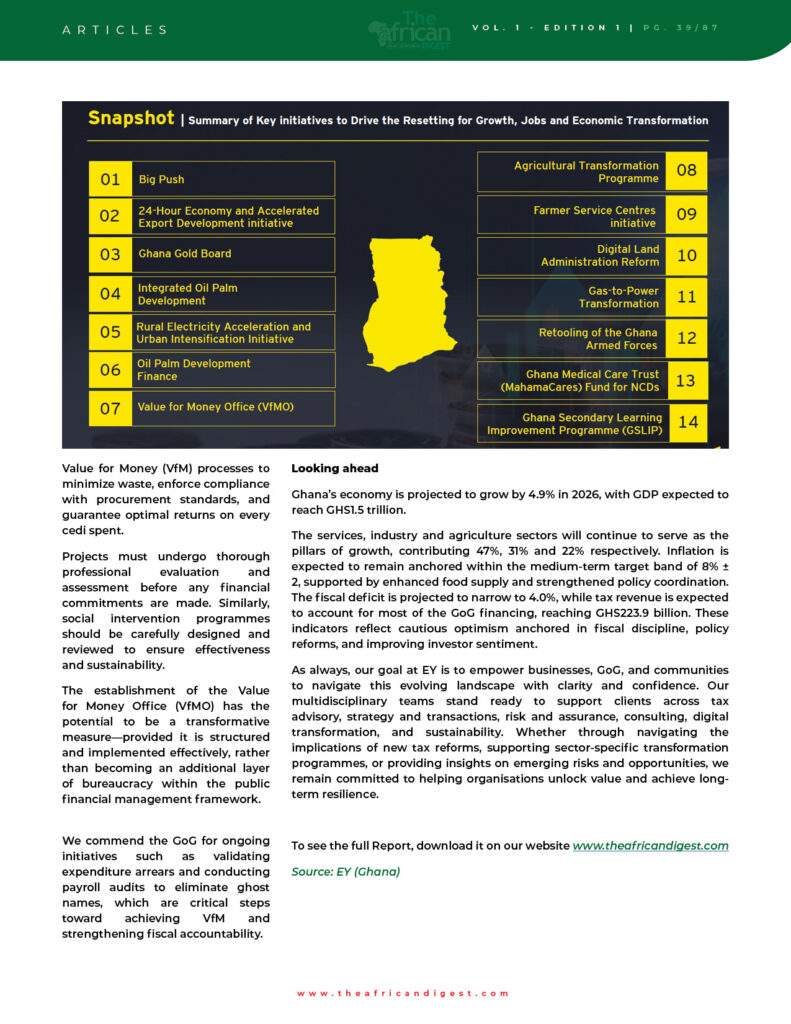
The Government of Ghana (GoG) has signalled a clear commitment to consolidating macroeconomic stability while pursuing transformative interventions across key sectors. The budget aims at decisive shifts from recovery to transformation; resilience to productivity; and from stability to jobs.

Emmanuel Adekahlor – Country Managing Partner, Ernst & Young (EY) Ghana
To see the full Report and Article, Download your Complimentary Copy Via the Button Below