




By Dr. Brian O. Reuben (Executive Chairman – Sixteenth Council UK)
Why the institutions that will define Africa’s future are not necessarily the ones dominating today.
There is a question that has occupied my thinking for many years.
Why do organisations with similar access to capital, talented people, technology, and opportunity produce such dramatically different outcomes?
It is tempting to assume that the answer lies in resources. It is an attractive explanation because it is measurable. Organisations with more capital should outperform those with less. Institutions with better technology should move faster. Governments with abundant natural resources should enjoy sustained prosperity.
Yet history repeatedly refuses to cooperate with that assumption.
- Kodak invented the digital camera, yet failed to lead the digital photography revolution.
- Nokia dominated the global mobile phone market, only to lose its position with astonishing speed.
- BlackBerry became synonymous with secure mobile communication before becoming largely irrelevant in a market it once defined.
The lesson is uncomfortable, and Success does not guarantee relevance.
In fact, success can become one of the greatest obstacles to relevance if it convinces leaders that yesterday’s assumptions will continue producing tomorrow’s outcomes.
This pattern extends far beyond business; Nations, Universities, Media organisations and Religious institutions all experience it. Even individuals experience same.
The challenge confronting leaders today is therefore deeper than competition; It is ‘relevance.’
We are living through one of the most significant periods of structural change in modern history where:
- Artificial intelligence is altering how value is created.
- Geopolitical rivalry is reorganizing supply chains and investment flows.
- Climate transition is reshaping capital allocation.
- Demographic shifts are redefining labour markets.
- Trust in institutions continues to decline while expectations of leadership continue to rise.
These are not isolated developments. Together, they represent a reconfiguration of the environment within which every organization must operate. And yet, many leadership conversations remain surprisingly narrow.
Executives continue discussing productivity. Governments continue discussing economic growth. Boards continue discussing governance.
And although these are all important conversations, they however are becoming increasingly insufficient.
The more fundamental question is this:
What are the invisible conditions that determine whether an institution continues to matter?
This is the question I have explored across my work with leaders in business, government, and international institutions.
Over time, I am more convinced that enduring influence rarely begins with products, capital, technology, or even strategy in the conventional sense.
It begins with something less visible; “How an organization shapes understanding”
Every market is influenced by narratives, and every investment decision reflects perception.
Every institution occupies a category in the minds of those it seeks to influence, and organisations either becomes more relevant over time or slowly becomes less necessary.
These observations eventually became the foundation of what I describe as the “Strategic Elevation Framework.”
This Framework is built around three mutually reinforcing disciplines:
The First – “Narrative Authority”
Markets rarely respond to facts alone. They respond to the meaning attached to those facts.
The institutions that consistently attract talent, investment, partnerships, and public confidence understand how to establish credibility before they ask for commitment.
They shape understanding before they seek agreement.
The Second – “Category Positioning”
Many organisations spend enormous amounts of energy competing within categories someone else created. The more influential organisations define the category itself.
Apple did not simply build computers. Netflix did not simply rent films. Tesla did not simply manufacture cars.
They all changed the frame through which people understood the market.
That is strategic positioning in its deepest sense.
The Third – “Strategic Relevance.”
This may be the most important discipline of all; ‘Relevance is not achieved once.’
It is continually earned.
The institutions that endure are those that recognize changing realities before circumstances force them to change. They evolve while still successful.
They question their own assumptions before competitors do and prepare for futures that remain invisible to others.
These three disciplines increasingly explain why organisations experiencing similar market conditions often produce profoundly different outcomes.
Africa’s future will depend upon leaders capable of thinking this way.
The continent possesses extraordinary entrepreneurial energy; Its population is young and Its digital economy continues to expand.
The African Continental Free Trade Area (AfCFTA) presents unprecedented possibilities as capital continues seeking opportunities across African markets.
Yet opportunity alone never guarantees transformation. Transformation depends upon institutions – Strong and Adaptive institutions.
Institutions capable of remaining strategically relevant over decades rather than electoral cycles or quarterly reporting periods.
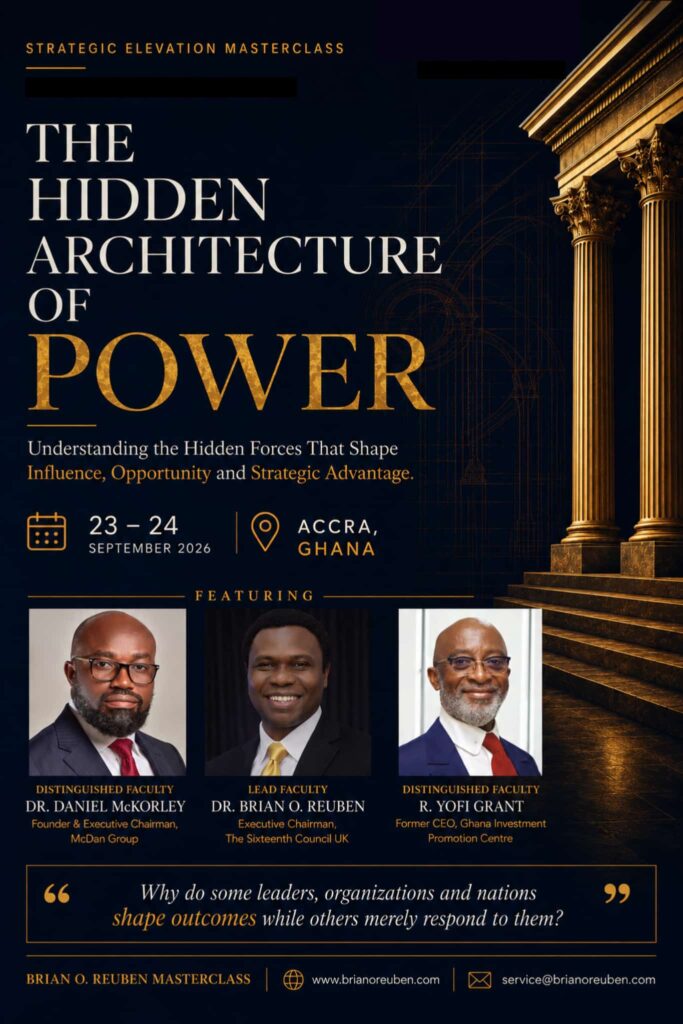
This conviction is the reason I am convening the inaugural Strategic Elevation Masterclass, which will take place in Accra, Ghana, from 23–24 September 2026.

The Masterclass is not designed as another executive training programme. Nor is it intended to be another conference where participants collect presentations before returning unchanged to familiar routines. Its purpose is different.
It is designed as an Executive inquiry into the ‘Architecture of enduring influence’.
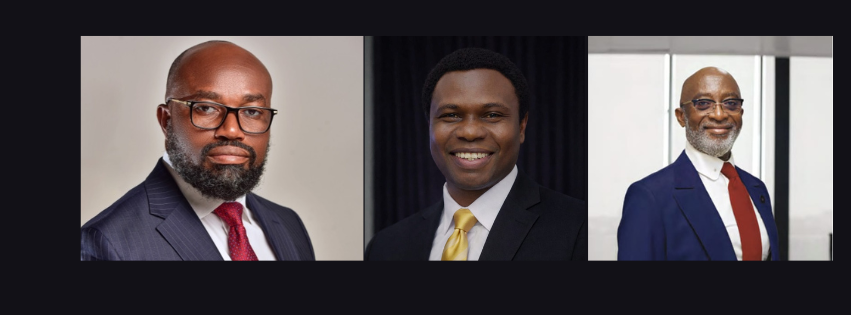
Joining me are two distinguished faculty members whose own careers reflect different dimensions of institutional leadership.
Dr. Daniel McKorley, Founder and Executive Chairman of the McDan Group, has built one of Africa’s most respected diversified enterprises. His experience illustrates what it takes to transform entrepreneurial ambition into an enduring institution.

Mr. R. Yofi Grant, former Chief Executive Officer of the Ghana Investment Promotion Centre (GIPC), whose leadership helped position Ghana as an increasingly attractive destination for investment and enterprise. His perspective bridges public policy, economic competitiveness, and long-term national strategy.

Together, we will explore questions that are rarely discussed in conventional executive programmes.
Why do some organisations shape industries while others merely participate in them? How is influence built before it becomes visible?
What distinguishes institutions that remain relevant across generations? And how should leaders prepare their organisations for a future that cannot yet be fully predicted?
These are not academic questions. They are practical questions.
These critical questions increasingly determine investment decisions, institutional resilience, organisational growth, and national competitiveness.
Africa neither lacks ambition nor talent.
What Africa requires is a deeper conversation about the architecture of enduring leadership.
And this conversation begins in Accra.
For programme information and the Executive Briefing, click on the link below: