

The pyramids of Giza and the Great Sphinx are among the most popular tourist destinations in the world, and indeed already were even in Roman times. Each of these spectacular structures served as the final resting place of a king of the 4th Dynasty (c.2613–2494 BC). The Great Pyramid of Giza was built for King Khufu (c.2589–2566 BC), and the other two for Khafre and Menkaure, his son and grandson. Khufu’s pyramid is both the oldest and largest of the three, and the first building to exceed it in height would not be built for another 3,800 years!
The Giza Plateau, located on the outskirts of Cairo, Egypt, is a UNESCO World Heritage site and home to the 4,500-year-old Old Kingdom necropolis. Its major landmarks include the Great Pyramids (Khufu, Khafre, Menkaure) and the Great Sphinx, built around 2600–2500 B.C.E. to serve as divine tombs.
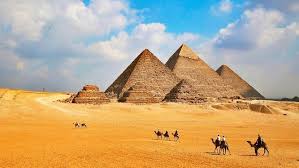
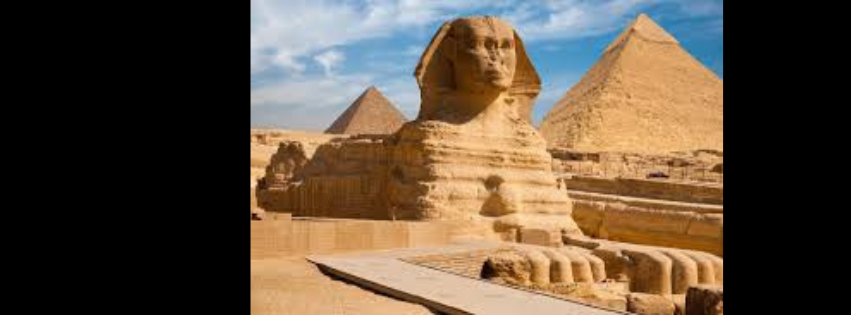
The Giza pyramid complex consists of the Great Pyramid (also known as the Pyramid of Cheops or Khufu and constructed c. 2580 – c. 2560 BC), the somewhat smaller Pyramid of Khafre (or Chephren) a few hundred metres to the south-west, and the relatively modest-sized Pyramid of Menkaure (or Mykerinos) a few hundred metres farther south-west. The Great Sphinx lies on the east side of the complex.
Current consensus among Egyptologists is that the head of the Great Sphinx is that of Khafre. Along with these major monuments are a number of smaller satellite edifices, known as “queens” pyramids, causeways pyramid temples, valley temples, harbours, three cemetery fields and a workers’ town.
Key Features and Landmarks
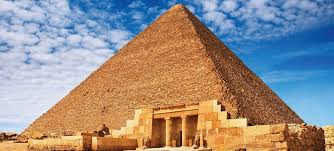
The Great Pyramid of Khufu (Cheops): The oldest and largest pyramid, originally 146.5 meters tall, it is the last surviving wonder of the ancient world.
The Pyramid of Khafre (Chephren): Built by Khufu’s son, it appears taller because it sits on higher ground and retains some of its original limestone casing at the apex.
The Pyramid of Menkaure (Mykerinus): The smallest of the three main pyramids.
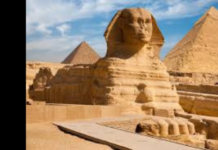
The Great Sphinx: A colossal statue with a lion’s body and a human head, believed to represent Pharaoh Khafre guarding his burial complex.
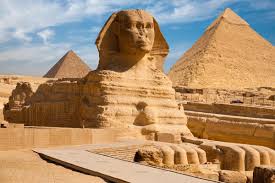
Surrounding Necropolis: Includes smaller “queen” pyramids, mastaba tombs for nobles, workers’ settlements, and mortuary temples.
Historical and Engineering Significance
The pyramids were built as massive tombs to protect the pharaohs’ bodies and provide for their journey to become gods in the afterlife. They were built with roughly 5.5 million tonnes of limestone and 8,000 tonnes of granite, transported to the site.
Visitor Information
Giza Plateau is located on the west bank of the Nile about 13 km from central Cairo.
Some fun activities you could engage in whilst you are there include: Exploring the plateau, entering the pyramids, visiting the Sphinx area, and camel or horse-drawn carriage rides. The site offers a direct window into one of the world’s first great civilizations, featuring tombs that illustrate the everyday activities and beliefs of the ancient Egyptians.
Great Sphinx of Giza
The Great Sphinx of Giza is a limestone statue of a reclining sphinx, a mythical creature with the head of a human, and the body of a lion. Facing directly from west to east, it was carved out of a low lying spur of the Giza Plateau on the west bank of the Nile in Giza. The face of the Sphinx appears to represent the pharaoh Khafre. The Sphinx is the oldest known monumental sculpture in Egypt and one of the most recognizable statues in the world. Archaeological evidence suggests that it was created by ancient Egyptians of the Old Kingdom during the reign of Khafre (c. 2558–2532 BC).
The original shape of the Sphinx was cut from the bedrock, and has since been restored with layers of limestone blocks. It measures 73 metres (240 feet) long from paw to tail, 20 metres (66 feet) high from the base to the top of the head and 19 metres (62 feet) wide at its rear haunches. Its nose was broken off between the 3rd and 10th centuries AD. The Arab historian al-Maqrīzī, writing in the 15th century, attributes the loss of the nose to Muhammad Sa’im al-Dahr.
The Giza Plateau is accessed by two main roads. The road from the north leads to Khufu’s pyramid; the other to near the Sphinx’s front court, from the east. They cross the Nile River from the east bank and follow the causeway westward. Dominating the plateau and running in a southwest diagonal through the site are the three pyramids of the pharaohs Khufu, Khafre, and Menkaure.
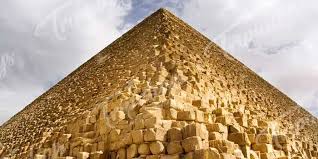
Although the three pyramids dominate the plateau, they are in fact surrounded by many other monuments. Every king’s pyramid was just one element albeit the most important of a larger complex that included smaller, subsidiary, queens’ pyramids; an additional one that acted as a second, symbolic, tomb for the king, called a satellite pyramid; mastaba tombs for nobility and other family members; burials of actual and/or symbolic boats; and a pair of temples linked by a richly decorated causeway. One of these temples, called the valley temple, led into the pyramid complex, and was located on or near a body of water where boats could dock. The other, the funerary (or upper) temple, stood near the base of the pyramid. Priests maintained the mortuary cult of the deceased king in these temples, where his divine aspect was worshiped, and where rich and diverse offerings were presented to his soul so he could have a peaceful and luxurious afterlife.
Stay tuned to our website to discover more of Africa’s Amazing Travel and Tourist Destinations