


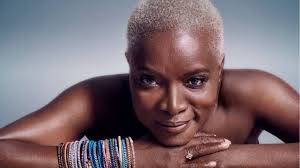
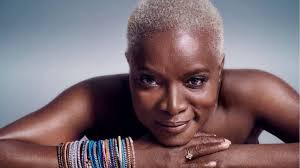
“I started singing when I was six years old, and I’m grateful every day that I still get to live my passion and do what I love with my life,” says Angélique Kidjo, who hails from the West African nation of Benin. “With this album I wanted to put some fire back in people’s hearts, and show how much we need that joy and hope to keep our humanity going.”
Five-time Grammy Award winner Angélique Kidjo is one of the greatest artists in international music today, a creative force with eighteen albums to her name.
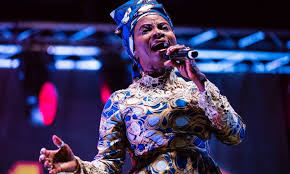
Angélique Kidjo (full name: Angélique Kpasseloko Hinto Hounsinou Kandjo Manta Zogbin Kidjo) is a Beninese musician, actress, and activist. Angélique Kidjo has won five Grammy Awards and a Polar Music Prize. She has collaborated with popular and renowned artists including: Alicia Keys, Davido, Ayra Starr, Stoneboy, Peter Gabriel, John Legend, Philip Glass, Bono, Yo-Yo Ma, and Burna Boy. She is the first Black African artist to receive a star on the Hollywood Walk of Fame. She also performed at the Tokyo 2020 Olympic Games Opening Ceremony on July 23, 2021.
In 2021, Time magazine included her in its list of the 100 most influential people in the world. Angélique Kidjo is fluent in five languages: Fon, French, Yorùbá, Gen (Mina) and English. She sings in all of them, and she also has her own personal language, which includes words that serve as song titles such as “Batonga”. Kidjo often uses Benin’s traditional Zilin vocal technique and vocalese.
A remarkable story
Since Angélique Kidjo first burst onto the global scene over four decades ago, her music has provided a powerful transmission of pure unfettered joy. In the last few years alone, the Africa-born artist has amassed a host of accolades proving her immense cultural impact, including winning the 2023 Polar Music Prize, landing on Time’s illustrious 100 Most Influential People list, and taking home a Grammy for Best Global Music Album for 2021’s Mother Nature (a feat that earned her Guinness World Record for most Global Music Album awards won at the Grammys, with five prizes to date). On HOPE!!, Angélique Kidjo offers up a revelatory body of work affirming her as a truly essential artist—one whose unbridled joy serves as a unifying force, a conduit for healing, and a much-needed antidote to despair in troubled times.
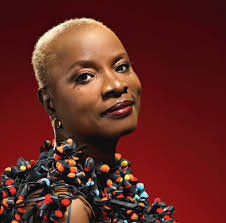
The 18th album in her widely acclaimed discography, HOPE!! pushes forward with the generation-spanning collaborative approach Angélique previously embraced on Mother Nature—an album that featured a stacked lineup of young artists from genres like Afrobeat, dancehall, and hip-hop.
Dedicated to Angelique Kidjo’s late mother, ‘HOPE!!’ emerged from a period shaped by grief and renewal. “My mother used to tell me that hope is the bedrock of our existence,” says Angélique.
As the latest offering in a catalog that’s continually shown the transformative power of music, HOPE!! solidifies Angélique Kidjo’s legacy as a visionary artist whose sense of purpose has only grown stronger over time. Kidjo also advocates on behalf of children as a UNICEF Ambassador, and has created her own charitable foundation, Batonga, dedicated to support the education of young girls in Africa.
Her Birth and Early childhood
Angélique Kidjo was born in Ouidah, French Dahomey, in what became Benin. Her father is from the Fon people of Ouidah and her mother from the Yoruba people. Her father was a musician, and her mother worked as a choreographer and theatre director. She grew up listening to Yoruba and Beninese traditional music, Miriam Makeba, Hugh Masekela, James Brown, Manu Dibango, Otis Redding, Jimi Hendrix, Fela Kuti, Stevie Wonder, Osibisa and Santana. By the time she was six years old, Kidjo was performing with her mother’s theatre troupe.
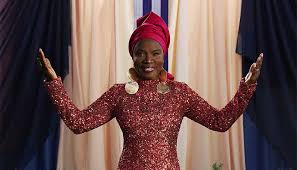
She started singing in her school band, Les Sphinx, and found success as a teenager with her adaptation of Miriam Makeba’s “Les Trois Z”, which was played on national radio. Kidjo recorded the album ‘Pretty’ with Cameroonian producer Ekambi Brilliant and her brother Oscar. It featured the songs “Ninive”, “Gbe Agossi”, and a tribute to the singer Bella Bellow, one of her role models. The success of the album allowed her to tour all over West Africa. Continuing political conflicts in Benin prevented her from being an independent artist in her own country and led her to relocate to Paris in 1983.
After moving to France, Angélique initially planned to become a human rights lawyer, but ended up studying music. While working various day jobs to pay for her tuition, she studied music at the CIM, a jazz school in Paris, where she met musician and producer Jean Hebrail, with whom she has composed most of her music and whom she married in 1987. She started out as a backup singer in local bands. In 1985, she became the front singer of Jasper van’t Hof’s Euro-African jazz/rock band Pili Pili. Three Pili Pili studio albums followed: ‘Jakko’ (1987), ‘Be In Two Minds’ (1988, produced by Marlon Klein) and ‘Hotel Babo’ (1990). By the end of the 1980s, she had become one of the most popular live performers in Paris and recorded a solo album called Parakou for the Open Jazz Label. She met Island Records founder Chris Blackwell in Paris; Blackwell signed her to a record deal in 1991. She recorded four albums for Island until Blackwell’s departure from the label. In 2000, she was signed in New York by Columbia Records, for whom she recorded two albums.
In 2006, Angélique Kidjo founded the Batonga Foundation with the stated goal of empowering and educating adolescent girls in sub-Saharan Africa. Kidjo invented the word “Batonga” as a child as a response to those who told her that girls did not belong in the classroom. Later, it would become the title of a hit song for her. The foundation has provided girls in five African countries (Mali, Benin, Sierra Leone, Ethiopia and Cameroon) with scholarships and in-kind support, supplied 8,727 students access to wells and latrines across seven schools in Benin, and offered 222,000 students in Benin’s poorest regions Toms Shoes for the walk to school.[citation needed] In 2015 and 2016, Batonga began to focus on education programs aimed at excluded young women and girls, providing girls with safe spaces and mentors, equipping them with life and financial literacy skills, and helping them start small businesses.
Angélique Kidjo got married to French musician and producer Jean Hébrail in 1987. Their daughter Naima was born in 1993 in France.
Her World Renowned Accolades
Angélique has received honorary doctorates from Yale University, Berklee College of Music, Middlebury College, and UCLouvain. In 2010, the BBC Focus on Africa magazine included Kidjo in its list of the African continent’s 50 most iconic figures, based on reader votes, and in 2020 she was on the list of the BBC’s 100 Women. In 2011, The Guardian listed her as one of its Top 100 Women in art, film, music and fashion and Angélique Kidjo is the first woman to be listed among “The 40 Most Powerful Celebrities in Africa” by Forbes magazine. She was listed among the “2014 Most Influential Africans” by New African magazine and Jeune Afrique. Forbes Afrique put Kidjo on the cover of their “100 most influential women” issue in 2015.
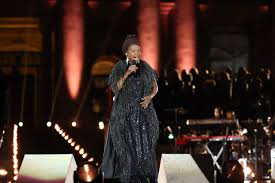
Angélique Kidjo is the recipient of the 2015 Crystal Award given by the World Economic Forum of Davos in Switzerland and she received the Ambassador of Conscience Award from Amnesty International in 2016. On September 15, 2021, Time magazine included her in their list of the 100 most influential people in the world.
On 3 July 2025, it was announced that Kidjo would be the first black African to get a star on the Hollywood Walk of Fame.
Angélique Kidjo’s first international album ‘Parakou’ was first released in 1989. It was the beginning of a series of collaborations with producer and composer Jean Hébrail and featured Jasper van’t Hof.
Angélique Kidjo’s Advocacy Programmes
Angélique Kidjo has been a UNICEF Goodwill Ambassador since 2002. With UNICEF, she has travelled to many countries in Africa. Reports on her visits can be found on the UNICEF site: Benin, Senegal, Ethiopia, Tanzania, Syria, Malawi, Uganda, Kenya, Sierra Leone, Zimbabwe, South Africa and Haiti.
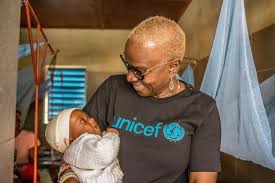
Along with Mary Louise Cohen and John R. Phillips, Angélique founded the Batonga Foundation, which empowers some of the most vulnerable and hardest-to-reach young women and girls in Benin with the knowledge and skills they need to be agents of change in their own lives and communities. Batonga accomplishes this by locating the most vulnerable adolescent girls in Benin and connecting them to girl-centred safe spaces led by Beninese women. These safe spaces provide young women and girls with training that allow them to gain new skills in financial literacy and build social capital.
She also campaigned for Oxfam at the 2005 Hong Kong WTO meeting, for their Fair-Trade Campaign and travelled with them in North Kenya and at the border of Darfur and Chad with a group of women leaders in 2007 and participated in the video for the in “My Name” Campaign with will.i.am from the Black Eyed Peas.
She hosted the Mo Ibrahim Foundation’s Prize for Achievement in African Leadership in Alexandria, Egypt, on November 26, 2007, and on November 15, 2008, in Dar es Salaam, Tanzania, on November 14, 2009, and in Mauritius on November 20, 2010. She hosted the “Africa Celebrates Democracy Concert” organized by the Mo Ibrahim Foundation in Tunis on November 11, 2011, and sang at the Award Ceremony on November 12, 2011, also in Dakar on November 10, 2012, Addis Ababa in November 2013 and Accra in November 2015.
Since March 2009, Angélique has been campaigning for “Africa for women’s rights”. This campaign was launched by The International Federation of Human Rights (FIDH).
On September 28, 2009, UNICEF and Pampers launched a campaign to eradicate Tetanus “Give the Gift of Life” and asked Kidjo to produce the song “You Can Count On Me” to support the campaign. Each download of the song donates a vaccine to a mother or a mother-to-be.
With Jessica Biel and Peter Wentz, Angélique was a Live Earth Ambassador for the 2010 ‘Run For Water’ events. Angélique Kidjo has recorded a video based on her song “Agolo” and on the images of Yann Arthus-Bertrand for the United Nations SEAL THE DEAL Campaign to prepare for the Copenhagen Climate Change summit.
The Commission of the African Union (AU) announced on July 16, 2010, the appointment of Kidjo as one of 14 Peace Ambassadors to support the implementation of the 2010 Year of Peace and Security program. She appears in the Sudan365: Keep the Promise video, to support the peace process in Darfur.
In June 2010, she contributed the song “Leila” to the Enough Project and Downtown Records’ Raise Hope for Congo compilation. Proceeds from the compilation fund efforts to make the protection and empowerment of Congo’s women a priority, as well as inspire individuals around the world to raise their voice for peace in Congo.
In 2011, Angélique collaborated with Forró in the Dark and Brazilian Girls on the track “Aquele Abraço” for the Red Hot Organization’s most recent charitable album Red Hot + Rio 2. The album is a follow-up to the 1996 Red Hot + Rio. Proceeds from the sales will be donated to raise awareness and money to fight AIDS/HIV and related health and social issues. Kidjo recorded a version of Fela Kuti’s “Lady” with Questlove and Tune-Yards for the Red Hot Organization in 2012.
In September 2012, she was featured in a campaign called “30 Songs/30 Days” to support Half the Sky: Turning Oppression into Opportunity for Women Worldwide, a multi-platform media project inspired by Nicholas Kristof and Sheryl WuDunn’s book. And on February 18, 2013, at the UNESCO headquarters in Paris, Kidjo was the host of a night of celebration for the cultural heritage of Mali. The event included performances by many Malian artists.
Angélique Kidjo met with US First Lady Michelle Obama to discuss international girls’ education, in the Eisenhower Executive Office Building of the White House. She was also one of the endorsees of the People’s Climate March. She joined the march in New York, along with Mary Robinson, and was interviewed by Amy Goodman for Democracy Now.
November 2014 saw Kidjo collaborating with many other artists as part of Band Aid 30, the 30th anniversary version of the 1980s ‘Supergroup’. And in 2015, she signed an open letter which the ONE Campaign had been collecting signatures for; the letter was addressed to Angela Merkel and Nkosazana Dlamini-Zuma, urging them to focus on women as they serve as the head of the G7 in Germany and the AU in South Africa respectively, which will start to set the priorities in development funding before the main UN summit in September 2015 that will establish new development goals for the generation.
Kidjo is a contributor to the Art Of Saving A Life Campaign initiated by the Bill & Melinda Gates Foundation. In 2015, she sang Afirika at the opening of the United Nations General Assembly in New York in support of the launch of the Global Goals for Sustainable Development along with Shakira after a speech by Pope Francis and before Malala.
At the G7 Summit in 2019, President Macron of France named Angélique Kidjo as the spokesperson for the AFAWA initiative (Affirmative Finance Action for Women in Africa) to help close the financing gap for women entrepreneurs in Africa.
Additional Sources: Angélique Kidjo’s Website, Wikipedia