
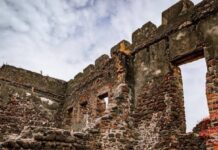



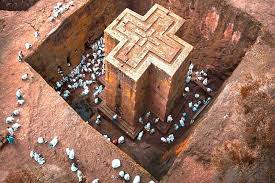
The eleven Rock-hewn Churches of Lalibela are monolithic churches located in the western Ethiopian Highlands near the town of Lalibela, named after the late-12th and early-13th century King Gebre Meskel Lalibela of the Zagwe dynasty, who commissioned the massive building project of 11 rock-hewn churches to recreate the holy city of Jerusalem in his own kingdom. The site remains in use by the Ethiopian Orthodox Christian Church to this day, and it remains an important place of pilgrimage for Ethiopian Orthodox worshipers. It took 24 years to build all the 11 rock hewn churches.
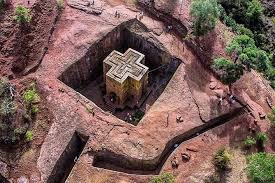
The 11 rock-hewn churches of Lalibela in Ethiopia, are 12th-13th century monolithic structures carved entirely out of solid volcanic rock in a “New Jerusalem”. Commissioned by King Lalibela, they are famous for their subterranean, top-down architecture, serving as a major pilgrimage center for Ethiopian Orthodox Christians.
The Astounding Architecture
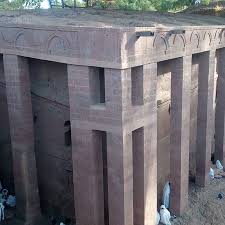
The rock-hewn churches of Lalibela Location are situated in the Lasta Mountains formerly known as Roha, in Northern Ethiopia. They were created by carving from the top down, separating the structure from the surrounding rock to create free-standing monolithic buildings (4 of the 11 initially created) or semi-monolithic spaces. They feature Axumite styles, including imitation windows and friezes.
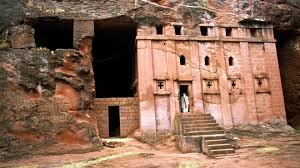
The archaeological site consists of five churches north of the town’s river Jordan, five south of the river, and one independently located. The churches in each grouping are connected by a system of tunnels and trenches. Biete Giorgis, the eleventh church, is connected to the others by trenches.
The churches are divided into two main groups by a water channel (Northern and Southern), representing the River Jordan, connected by a network of tunnels and trenches.
According to local tradition, Lalibela (traditionally known as Roha) was founded by an Agew family called the Zagwa or Zagwe in 1137 AD. Tradition holds that in Ethiopia prior to his accession to the throne, Gebre Meskel Lalibela was guided by Christ on a tour of Jerusalem, and instructed to build a second Jerusalem in Ethiopia. The churches are said to have been built during the Zagwe dynasty, under the rule of King Gebre Mesqel Lalibela (1181–1221 AD), although it is more likely that they evolved into their current form over the course of several phases of construction and alteration of preexisting structures.
All 11 churches were the result of a process using the basic tools of hammers and chisels to excavate trenches surrounding the monolithic and semi-monolithic structures, as well as a system of tunnels which connected two separate groups of the churches with each other out of the scoriaceous basalt. The “construction” was done from top to bottom.
Religious significance and function
The Churches of Lalibela hold important religious significance for Ethiopian Orthodox Christians. Together they form a pilgrimage site with particular spiritual and symbolic value, with a layout representing the holy city of Jerusalem. The site continues to be used for daily worship and prayer, the celebration of religious festivals like Timkat and Genna, as a home to clergy, and as a place which increasingly brings together religious adherents and leaders every year.
Stay tuned to our site to uncover more African Historical Destinations