



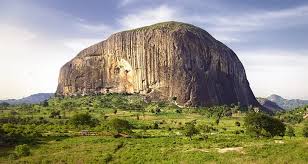
“The rock with a human face”
Zuma Rock is a massive 725-meter (2,379 feet) high igneous intrusion monolith located in Niger State, Nigeria, famously known as the “Gateway to Abuja”. Often called the “rock with a human face” due to natural weathering, it is a premier, 500-million-year-old tourist site featured on Nigeria’s ₦100 (One Hundred naira) note.
Zuma Rock is a large rock composed of gabbro and granodiorite and of Precambrian age, located in Madalla, a town in Niger State, Nigeria. It is situated in the west of Nigeria’s capital, Abuja, along the main road from Abuja to Kaduna (North-West of Nigeria), off Madalla, and is sometimes referred to as the “Gateway to Abuja from Suleja”. Zuma Rock rises approximately 725 metres (2,379 feet) above sea level. It was once thought to be within the Federal Capital Territory of Nigeria, however it is actually located at the upper end of Madalla, a rural settlement in Suleja Local Government Area of Niger State.

Zuma Rock depicted on the 100 naira note, was once used for a defensive retreat by the Gbagyi people against invading neighbouring tribes during intertribal wars.
The History
The rock was found in the 15th century by the Zuba people of Niger State, who called it zumwa, which could translate to “a place of guinea fowls”. It had been known by that name earlier in the 15th century when the ‘Kwararafa’ (Kororofa) had started to spread all over the northern areas of Nigeria. The people of Zuba today were once part of the Kwararafa that are called or identified today as Koro. They are now part of the ‘Jukun’ that are in diaspora. The forefathers spread from the Kwararafa empire, travelled to the western direction through ‘Lafia’ (but Lafia was not there as at that time), then through Keffi area (but there was nothing like Keffi as at that time), then into the old Abuja area which was not in existence then too. But before they reached the Zuma Rock, their soothsayers told them that they were not to settle down permanently until they had reached one wonderful rock, far ahead of them. They continued to move approaching the Zuma rock till they came to meet the Zuma rock in the middle of a thick forest. When they entered into the forest, they settled within a mile radius around it and founded settlements like Shinapa (where their leadership was), Chaci, Luki, Esa, Zumwa, Yeku, Huntu, Wagu of the upperland and Wagu of the lowerland.
‘Fetish’ village
In the forest surrounding the rock, there existed a village inhabited by the Koro people, whose chief served as the priest of the rock’s deity. This deity was associated with a small rock within the village where sacrifices were believed to occur. The inhabitants of this forest village were said to protect the rock, preventing ‘outsiders’ from reaching it. There was a prevailing belief that no person had ever reached the rock’s base due to superstitions and the fear of a curse. Additionally, it was believed that the village itself was hidden from sight. Historically, the Emir of Abuja sent annual sacrifices—a black ox, a black he-goat, and a black dog—to the guardians of the rock as offerings to the deity. These sacrifices were delivered by villagers from ‘Chachi’, who were permitted to interact with the guardians due to their shared tribal connections.

Zuma Rock dubbed “Zumwa” (“place of guinea fowls”) was considered a sacred, powerful deity. The Rock served as a spiritual protector and defensive, hidden refuge for local communities against invaders.
Indigenous groups, including the Gbagyi, revere the rock as a guardian, offering sacrifices to it for protection.
A natural weathering phenomenon, a human-like face with eyes, nose, and mouth is visible on the rock’s surface, which locals believe represents the deity controlling the community’s affairs. Formed over 500 million years ago, the rock is composed of gabbro and granodiorite. Legend suggests the rock causes the surrounding area to fire up during the rainy season due to friction
Several centuries down the line, Zuma Rock still has multiple mysterious stories woven around it. Some natives have tales of unseen evil spirits dwelling in the belly of the rock. Others regard it as a den for ritualists, a hidden temple for initiation into the world of the occult and an abode for daredevil armed robbers who seek temporary refuge there whenever they conclude a successful operation and want to share their loot or when security agencies are on their trail.
Not far from the rock is an uncompleted white edifice known as the Zuma Rock Hotel. Some residents of the area believe that the hotel was a haunted zone, hence it was abandoned by its owners. In the course of exploring the area and trying to fix the jig-saw puzzles of the rock, residents living within the radius of the rock gave varying accounts. Some are of the opinion that the evil spirits had relocated, giving people a respite to now begin farming on the parcels of land near the rock. Yet some residents said the evil spirits were still living in the bowels of the rock and do exhibit strange powers especially during odd hours of the night.
The First Man to Climb Zuma Rock is Mainasara Kubashiyaki. His story goes way back to the time of the great King Odinaka of Sokoto.
Discover more of Africa in our upcoming Magazine.