

Nyungwe Forest National Park is one of the largest parks that has significantly boosted Rwanda’s tourism industry, generating millions of dollars annually. Nyungwe is well known for chimpanzee tracking which is the main activity carried out in the forest.
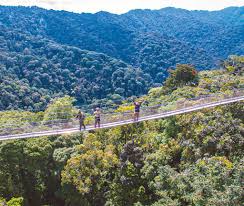
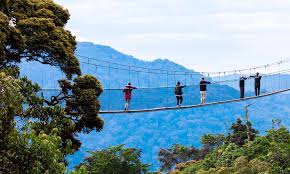
The Forest National Park, located in southwestern Rwanda and designated as a UNESCO World Heritage site in 2023, is one of Africa’s oldest and largest high-altitude montane rainforests. Spanning 1,019 sq. kilometres, this biodiverse park is a critical conservation area hosting 13 primate species (including chimpanzees), over 300 bird species, and a famous 160-meter-long canopy walkway.
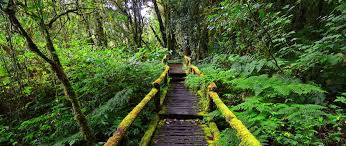
Situated in the Albertine Rift, the park sits at an altitude ranging from 1,600 to 2,950 meters, featuring steep mountains, deep valleys, and marshes. Known as the “water tank” of Rwanda, it feeds both the Congo and Nile river systems.
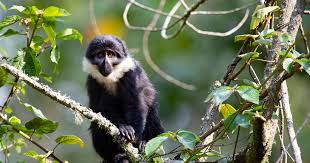
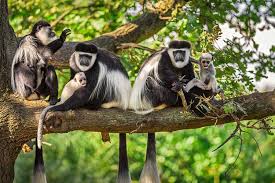
The park boasts over 1,000 plant species, including 248 orchid species and large mahoganies. It is also home to 85 mammal species, with the largest troop of black-and-white colobus monkeys in Africa and a significant population of chimpanzees.
The park has only two habituated chimpanzee groups: a small one of about 30 chimpanzees in Cyamudongo Forest and a larger group of around 60 chimpanzees. Nyungwe Forest national Park, Africa’s largest Afro-Montane Forest is also famous for the canopy walk where visitors can hike to the top of the trees and walk across hanging bridges to admire the forest’s beauty. Located southwest of Rwanda, near the Rwanda’s border with Burundi, south of Lake Kivu, and west of the Democratic Republic of Congo (DRC), the park is in the Rusizi District of Southwestern Rwanda.
Rusizi District is home to the park as well as Africa’s great river system on the east side of the Nile and west part to the DRC. Uwinka, the park’s headquarters is about 219kilometres away, approximately a 4-hour drive. The forest has a significant impact on Rwanda’s climate. Established as a National Park in 2004, Nyungwe hosts over 1,000 animals, birds and plant species, making it an important conservation area in Africa and a popular tourist destination for those wishing to visit Rwanda.
Situated in the Western Rift Valley, Nyungwe Forest National Park stretches from Lake Albert to Lake Tanganyika, passing through mountains and lakes that drain west into the Congo River System. The Albertine Rift is known for its stunning landscapes and endemic flora and fauna. Nyungwe boasts of about 1,068 plant species, including over 200 tree species and 248 orchid species with new species discovered every year.
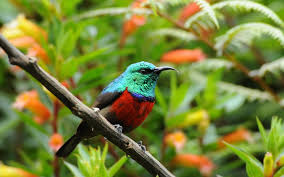
It also has around 85 mammal species, including 13 primates, and over 300 bird species, 29 of which are endemic to the Albertine rift, making it a prime bird-watching location often fondly called birds’ paradise. The park’s biodiversity is further diverse including swamps, marshes, bamboo thickets, heartlands, open woodlands and many microhabitats. Known for its 13 primate species, including the famous chimpanzees, Nyungwe is considered the best site for chimpanzee tracking and hosts the largest troop of black-and-white Colobus monkeys.
There are also fragmented forests like Cyamudongo, home to well-habituated chimpanzees, and Gisakura, where a smaller troop of Colobus Monkeys live, offering the chance to enjoy its beauty and fresh air.
The park has three main reception centers: one in Kitabi near the entrance, Uwinka in the middle of the park , and Gisakura. Camping Activities are available at Uwinka, including a tented camping ground though there are no hotel facilities inside the park, only around it.
Brief History of the Park
It is said that the Park existed for many years since year 1903 when the German Colonial Government declared the park a reserve, and a colonial crown land of Nyungwe. However, in 1958 and in 1973 the National Park was reduced in size by the fires. Poaching of animals increased, deforestation and other factors reduced the park to just 150 sq. kilometres. A large number of elephants were killed and in the year 1975, Buffaloes were also poached and killed in this onslaught. On a better note, the population of Colobus Monkeys grew to about 400.
There was however a set-up of research facilities in Uwinka and during the genocide in 1994, there was the destruction of all the facilities in Uwinka. After the destruction of the tourist facilities in 1994, restoration of the facilities which started in 1995 and continued until 2004 when the park was declared a National Park. By this time, Rwanda had been listed among the top tourist destinations and this saw an increase in the tourism sector.
Seeing the Chimpanzees and Wildlife at the Nyungwe Park
Two main groups of Chimpanzees current exist in Nyungwe Forest National park, the smaller group found at Uwinka and the other larger group found Cyamudongo as a fragmented part of the forest.
Trekking to see the chimpanzees in Cyamudongo will depend largely on where exactly the chimpanzees are located at the time you are there, and the round trip for this should be around 4.2 kilometres. And should take close to an hour of walking and an estimated three hours of looking through tree tops to see the chimps, monkeys and birds in the forest.
The best times to easily see the chimpanzees is between the hours of 4 – 4:30am in the mornings in June, July and August. The fig trees in the park are the fruits which make the forest an ideal one for Chimp-trekking. The chimpanzees feed until much later in the morning so tourists sleeping until normal hours still get a good chance to see them.
Top Attractions and Activities
- Chimpanzee Trekking: The main draw, offering opportunities to track semi-habituated chimpanzee troops in the Cyamudongo forest or the main Nyungwe forest.
- Canopy Walkway: Suspended 50 meters above the forest floor, it offers a dramatic, aerial view of the forest canopy.
- Hiking Trails: Over 13 diverse, well-maintained trails totaling over 130 km allow for in-depth exploration of the forest.
- Bird Watching: With over 300 bird species, 29 of which are Albertine Rift endemics, it is a premier birding destination.
- Waterfalls: Popular hikes lead to the Kamiranzovu and Ndambarare waterfalls.
- Cultural Experience: Nearby community cooperatives provide insight into local Rwandan customs, music, and dance.
The Best Time to Visit Nyungwe Forest National Park is during the dry season (June–September and December–February). Then it is ideal for trekking, though the park is open year-round.
The park is a roughly 5-6 hour drive from Kigali. Ranging from luxury options like One & Only Nyungwe House to mid-range lodges in the nearby Gisakura area.
Are you planning your next trip to Africa for business or pleasure? Then add a visit to Nyungwe Forest National park to you bucket list! The place is simply natural and exciting …
Additional Source: Nyungwe Forest National Park